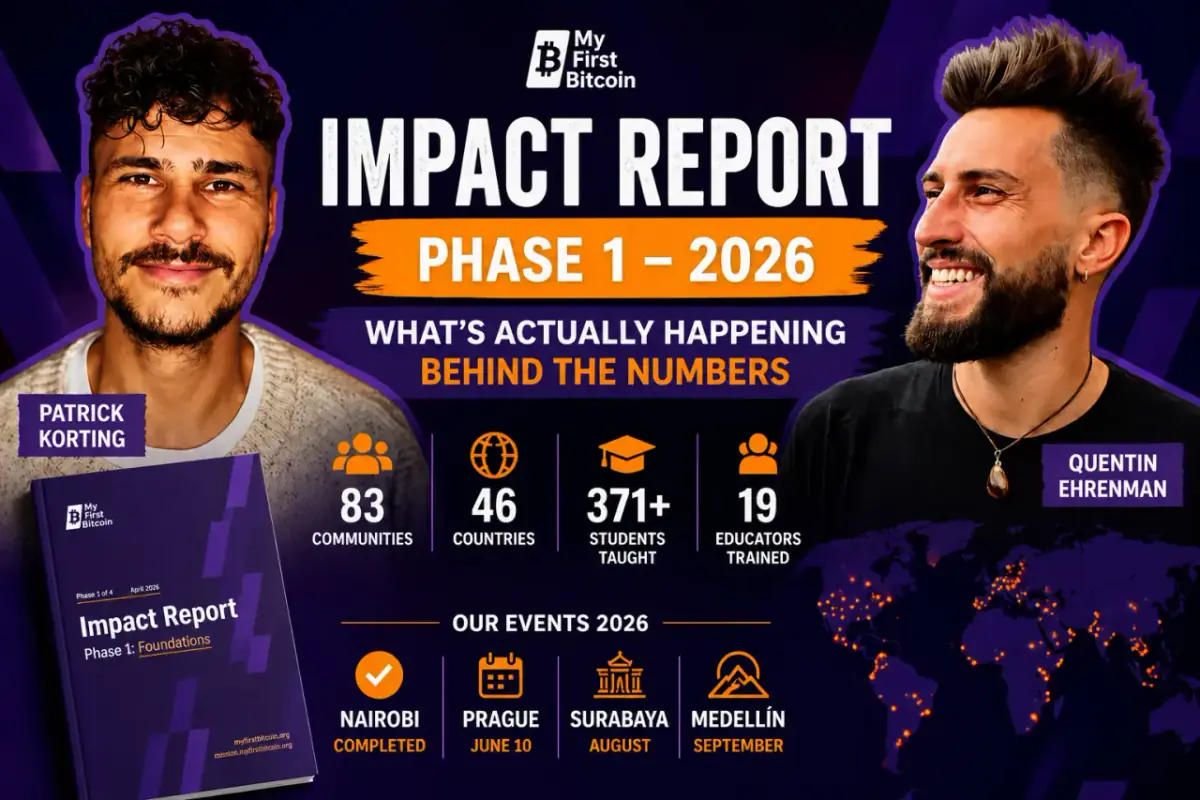
In the past three months, My First Bitcoin has shifted from a local education initiative to a global network of educators. This report marks the beginning of a new phase. Internally, the team has been transitioning from “doing the work” to enabling others to do it. That sounds simple, but it changes everything.
Instead of measuring success by how many students we teach directly, the focus shifts to how many educators we can support - and how effective they are in their own communities. That’s also why impact becomes harder to measure. You’re no longer counting outputs; you’re trying to understand whether people are actually becoming more independent and capable. The report is an attempt to make that visible, even if it’s imperfect.
The network now spans 83 communities across 46 countries, with new projects emerging every month. The report covers how this network is growing, what’s happening on the ground (especially in Kenya), how open-source education is scaling to 40+ languages, and why the real goal is not to grow the organization - but to make it obsolete.
Bitcoin doesn’t spread through technology alone. It spreads through people. And people need education to actually understand and use it. That’s the role My First Bitcoin is trying to play - not as the center of the system, but as a catalyst.
What the Report Covers
- A global year ahead - From Nairobi to Prague, Surabaya, and Medellín, how local events are strengthening a global network of educators.
- From initiative to network - How My First Bitcoin is evolving from teaching students to enabling educators, and why that changes everything.
- Nairobi Unconference: where it became real - A look inside the April 4th event where Bitcoin education moved from theory to lived experience.
- The Core (Kenya): a model that scales - How one community is creating multiple generations of educators, and what that means for the future of the network.
- New communities, same mission - Emerging projects across the world, and how local ownership is driving rapid, independent growth.
- Scaling education through open infrastructure - Program updates and the role of AI-powered systems in reaching 40+ languages and beyond.
- Finances and transparency - How funds are used, why it matters, and what it takes to sustain an independent, donation-driven movement.
- What comes next - Key milestones ahead, including Prague, major releases, and the next phase of network growth.
- Beyond the numbers: the human story - A first look at the My First Bitcoin documentary, capturing the real impact of education on the ground in Kenya.
Prefer to Listen?
If you’d rather listen than read, we’ve got you covered. In this episode, Patrick (Director of Communications and Events) and Quentin (Executive Director of My First Bitcoin) walk through the report together - what changed over the past three months, what’s working, and where things are heading next.
It’s a more detailed, unfiltered version of what you’ve just read, and a good option if you’re on the go or simply prefer hearing the conversation firsthand.

Our Events in 2026: Nairobi, Prague, Surabaya, Medellín
We just wrapped up our event in Nairobi - and it set the tone for everything that follows this year. The energy, the people, and the level of real adoption on the ground made it clear why these gatherings matter. If you want more details on what happened there, you’ll find them below.
The next stop is Prague. On June 10th, we’re hosting the Educators Unconference together with our partners from AmityAge. It’s deliberately not a typical conference.
Apart from a few anchor moments - like the premiere of the Nairobi documentary and a first look at the new platform - there’s no fixed agenda. The people in the room decide what gets discussed. That tends to lead to very different conversations. Less surface-level, more honest exchange between people who are actually teaching and building on the ground.
Prague is just the beginning. We’re continuing this format with partners from the network in Surabaya (Indonesia) in August and in Medellín (Colombia) in September. The idea stays the same: bring educators together locally, let them learn from each other, and strengthen the network where it actually matters.
The Education Network
The network is growing steadily, but what matters more than the numbers is the structure behind it. These 83 communities are not branches or franchises. They’re independent projects that choose to use the material and contribute back to the network.
Our flywheel: students become Bitcoiners, Bitcoiners become educators, educators build communities - and those communities create the next generation. You can already see that effect starting to compound.
The interesting part is that this growth is happening without significantly increasing the size of the core team, which is exactly the point.
Inside the Nairobi Unconference
The event in Nairobi was one of those moments where things stop being abstract. You can read reports and look at dashboards, but being there changes your understanding. Around 500 people showed up, with roughly 200 graduates, and the energy was very different from typical Bitcoin conferences.
Less focus on products, more on learning and sharing. What stood out in the conversation was how normal Bitcoin already feels in these environments.
Not as an idea, but as a tool people use. For many attendees, it wasn’t about “why Bitcoin,” but about “how do we expand this further?”
The Core (Kenya): A Model That Scales
Felix and The Core are probably the clearest example of what the model is supposed to produce. He didn’t just teach hundreds of students - he created educators who went on to start their own communities. Now you’re looking at multiple generations of teaching emerging from a single starting point.
This is where the idea of the flywheel becomes real. During the podcast, this was described less as growth and more as ignition. Once it works, it keeps going without needing constant input from the center. The challenge now is maintaining quality as this spreads.
New and Growing Communities
What’s encouraging is that this isn’t limited to one region. New communities are emerging in places like Zambia, Serbia, and Indonesia, all with different contexts but similar motivations.
The Zambia example in the report shows how quickly things can move when local educators take ownership - hundreds of students, multiple cohorts, and businesses starting to engage. These are not large, well-funded operations. Most of this work is happening on a voluntary basis, which makes the consistency even more impressive.
Scaling Education Through Open Infrastructure
A lot of the work this quarter didn’t look exciting from the outside. Fewer visible updates, more time spent on infrastructure. But this is where one of the biggest breakthroughs happened. The team built a system that allows content to be translated and adapted at scale, without having to redesign everything manually each time. That’s how the programs reached over 40 languages.
It’s not just about translation - it’s about making sure the material actually works in different contexts. The next step will be letting the community improve these translations continuously, instead of relying only on the core team.
Read more in A New Chapter in Bitcoin Education.
Finances and Transparency
The report also includes a transparent breakdown of finances. This isn’t just a formality. Since the organization is donation-based, there’s a responsibility to show clearly how funds are being used.
A large portion goes into the team and program development, which makes sense given the focus on infrastructure and training. The key takeaway is that the organization is stable, but still dependent on continued support from the community.
What Comes Next
Looking ahead, most of what’s coming builds on the same direction: better infrastructure, more support for educators, and more ways for the network to collaborate.
Prague will be an important checkpoint, with several updates and launches planned around that event. The bigger release is expected in October, which will likely include more visible changes.
Beyond the Numbers: The Documentary
One limitation that kept coming up during the conversation is that reports can only go so far. You can explain things, but you can’t fully show what it feels like on the ground.
That’s why the team started working on a documentary in Nairobi. It focuses less on the organization and more on the people - how they think, what changes for them, and why this matters in their daily lives. The first episode will be shown in Prague.