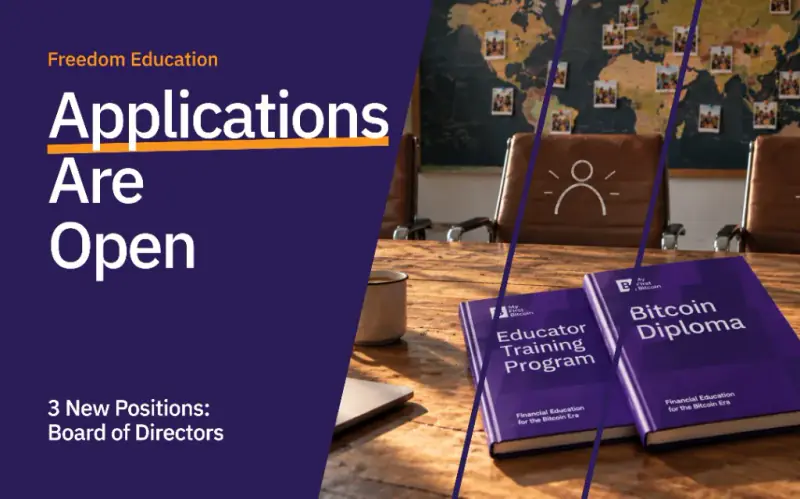
If you teach Bitcoin, or want to, the Bitcoin Diploma you know is changing. The October 2026 release brings a version that takes about half the pages, can be taught in a single day or spread over a month, and leaves real space for you to bring your own stories, tools and community into the classroom.
Pablo, Bitcoin educational designer at My First Bitcoin, led the redesign. In a conversation with Patrick, who leads communication and events, he explained what changed and why.
Three ideas stand out: less content can mean more freedom, Bitcoin education has to be local, and a diploma should mean something.
The October 2026 Release in Slides
Click through the slides for an overview of the whole release, from the programs to what changes for educators.
Less Content, More Room for the Educator
The redesign started with listening. In early 2026, a survey of the education network confirmed what educators had been saying for a while: the diploma was complete, but it was long and dense. The old version had ten chapters of one to two hours each. Taught once a week, that meant around ten weeks, and many students dropped out along the way.
The new Bitcoin Diploma has a minimum of eight hours and no upper limit. You can teach it in one intensive day, over a weekend, across a week or over a month.
Pablo compares the result to a race car: the direction stays the same, but everything that slowed it down is gone. The printed student guide is now about half its previous length, which also cuts printing costs for communities where every page counts.
Shorter does not mean emptier. Some technical depth, such as detailed mining and Lightning Network content, has moved into new advanced modules that educators can pick and teach after graduation, one topic at a time.
Much of the material from Bitcoin for Organizations, which is being retired, lives on in those modules too. The self-paced online diploma is also being retired, so that learning happens with an educator and a community.
The goal of trimming is to give educators space, not to give them less. As Pablo put it:
“Making space isn’t making the diploma less. It’s actually increasing the amplitude of where the educator can take this thing.”
Bitcoin Education Has to Be Local
The old diploma grew out of El Salvador, and it showed: remittances, the US dollar, tools that made sense in one place. But Bitcoin is used in very different ways around the world.
Patrick and Pablo shared examples from Indonesia, Kenya, Germany, Canada and Colombia, where laws, tools and daily needs look nothing alike.
So the new diploma stops trying to describe a single reality.
The new Bitcoin Diploma is organized into four modules, each addressing a different part of the learning journey:
- Understanding Money (Problem): Why money exists, how modern monetary systems work, and the trade-offs they create.
- How Bitcoin Works (Solution): Bitcoin’s fundamental principles, including its rules, properties, and how it addresses monetary challenges.
- Using Bitcoin Safely (Action): Practical skills such as wallets, self-custody, and protecting your Bitcoin.
- Bitcoin in Your Community (Connect): Exploring local Bitcoin adoption, relevant tools, merchants, regulations, and real-world use cases.
The modules don’t have to be taught in a fixed order. Educators can start wherever their students are most curious or where Bitcoin is most relevant to their local community. A class might begin by setting up a wallet, exploring local Bitcoin adoption, or questioning how money works.
The fourth module is particularly flexible: educators shape it around their own communities, bringing local experiences, challenges, and opportunities into the classroom.
The result is a curriculum that provides a shared foundation while giving educators the freedom to make Bitcoin education relevant to the people in front of them.
Even the history of money is open to local stories. Educators are invited to explain their own currency, where it came from and what happened to it.
In Pablo’s words:
“It’s not a history of our money, it’s a history of your money.”
Across the whole diploma, half the time is theoretical and half is practical.
A Diploma That Means Something
Making the diploma more accessible came with raising the bar for what graduating means.
Pablo described a pattern many will recognize: one educator reading slides to a silent online room, with no way to know what anyone learned.
The new diploma includes competency-based assessment. By the end, students should be able to explain key ideas and show that they can actually use Bitcoin, including self-custody.
Educators decide whether a student is ready to graduate based on those outcomes, not on attendance.
Pablo was open that certification without central control is hard to get right, and that this is a starting point the network will keep refining.
Each module follows a simple teaching rhythm:
- Explain: introduce the key concepts.
- Practise: work through activities and exercises.
- Apply: connect the learning to everyday life.
- Reflect: consider what was learned and what was difficult.
The student guide is now only for students, and everything educators need to run a class has moved into a fuller educator guide.
A new activity library with 30 activities lets educators choose, adapt and contribute games and exercises, all open source.
The diploma still rests on the same principles: open source, community-led, Bitcoin only, and focused on independent reasoning.
It now includes more questions that invite students to decide for themselves whether Bitcoin is the right tool for them, including its trade-offs.
What This Means If You Already Teach
If you teach the previous diploma, it is still valid. You can keep using it until you feel ready to switch.
A quick start guide summarizes the changes, and the Educator Training Program offers support as you make the move.
This release is also an invitation. The new diploma exists because educators gave feedback, and the next release in April 2027 will be shaped the same way.
Read it, teach it, proofread it in your language, and tell the team what works and what does not.
Download the new Bitcoin Diploma and share your feedback.
Watch the full conversation between Pablo and Patrick on YouTube.